
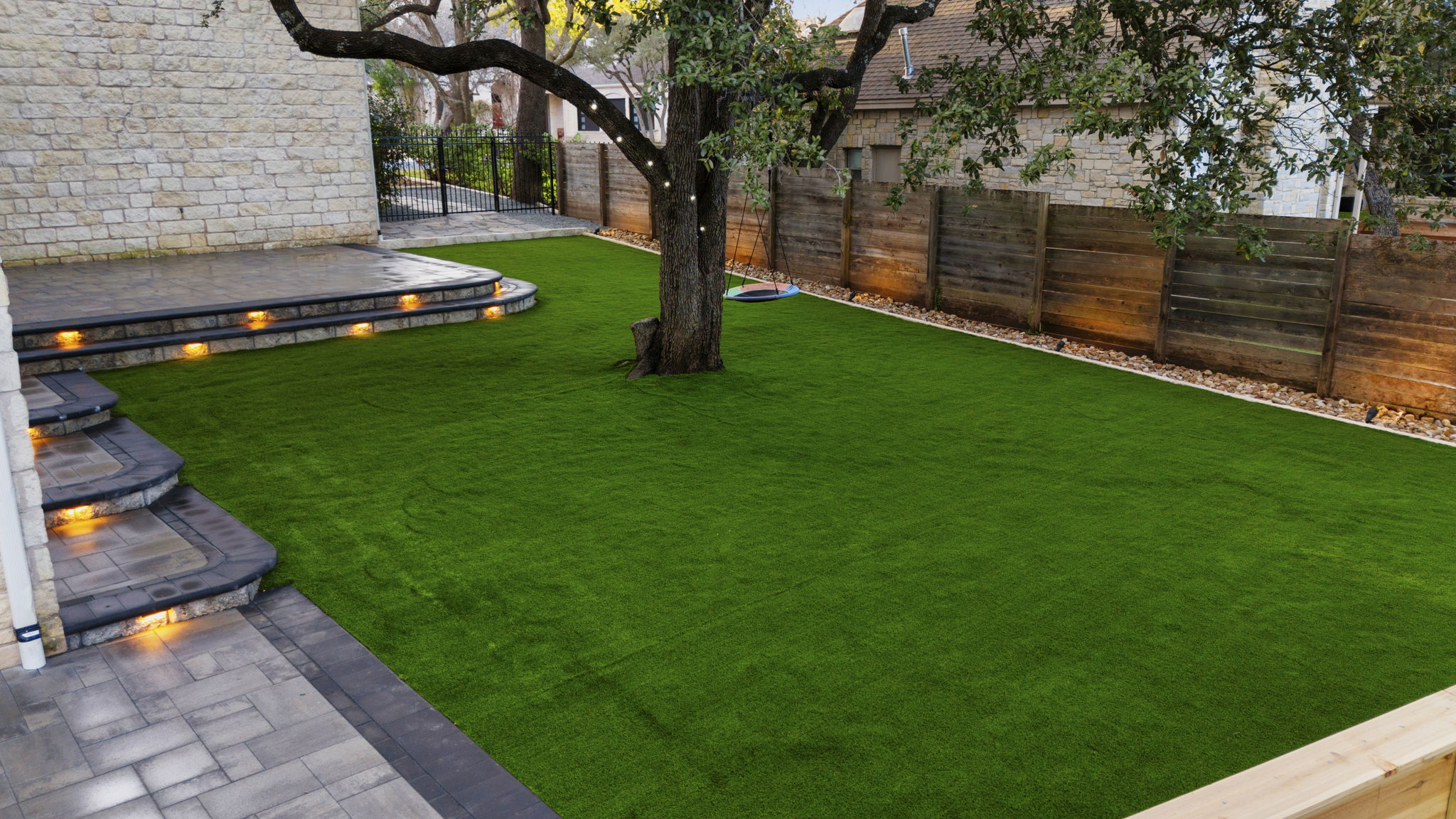
Artificial turf in Celina does not maintain itself. That is not a sales qualification—it is an honest correction to a misunderstanding that leads to neglected installations that underperform and age prematurely. The honest picture is this: synthetic grass in a North Texas yard eliminates mowing, irrigation, fertilization, and pest management. What it requires in exchange is periodic professional maintenance to keep fibers upright, infill distributed evenly, drainage paths clear, and surfaces clean. Artificial Turf of Celina's maintenance program is designed around what Celina's specific environment actually does to an installation over twelve months.
Collin County's spring pollen season is significant. Oak, cedar, elm, and grass pollen accumulate on synthetic surfaces at the same rate they accumulate on any horizontal surface in the area. Left unaddressed, pollen buildup works into the infill, compacts under foot traffic, and begins to form a crust that impairs drainage and dulls the surface appearance. A professional spring maintenance visit—power brushing followed by rinse and re-grooming—clears this accumulation before summer heat bakes it in.
Fall brings a different challenge. Celina has significant tree coverage in its established master-planned neighborhoods—the mature oak and pecan trees in Light Farms' older phases, the fast-growing deciduous trees planted along Mustang Lakes' streetscapes. Leaf debris on artificial turf is manageable with a leaf blower but accumulates more quickly than most homeowners expect in October and November. Organic material that is not removed begins to decompose in the infill layer, which promotes bacterial growth and can cause discoloration over time. A fall professional visit removes this material comprehensively, including from seam lines and perimeter edges where hand raking cannot reach.
Winter maintenance in North Texas is situational. Celina typically sees a handful of freeze events per season. Frozen water on a synthetic surface does not damage the turf itself, but freeze-thaw cycling can stress seam adhesives and edge anchors if installation quality was marginal to begin with. Our maintenance visits include a seam and edge inspection that catches developing separation before it becomes a full seam failure requiring adhesive repair.
Pet-specific maintenance is its own category. Households in Celina's new-construction neighborhoods that chose zeolite infill for pet applications benefit from an annual odor-control treatment that refreshes the zeolite layer's ammonia-capture performance. We also inspect the high-use bathroom zones within pet yards for infill compaction—these areas absorb more liquid load than surrounding surfaces and need infill top-up more frequently.
Our maintenance team brings professional power brushing equipment, commercial-grade blowers, and infill replenishment materials to each visit. We do not send a residential lawn crew with consumer tools. The difference in result quality between professional equipment and household tools is significant—comparable to the difference between a professional power washing truck and a consumer garden hose.
Maintenance scheduling is available as a single annual visit or as a managed seasonal program. We recommend the seasonal program for pet yards and commercial properties, and annual visits for standard residential lawns in Celina's newer neighborhoods where debris load and traffic volume are moderate.
Benefits
- Spring pollen removal prevents organic crust formation in infill before summer heat bakes it in
- Fall leaf debris extraction from seam lines and perimeter edges where homeowner tools cannot reach
- Zeolite infill odor-control treatment refresh for pet yard applications
- Seam and edge inspection catches developing adhesive failure before full separation occurs
- Infill depth assessment and redistribution to even coverage across high and low use zones
- Drainage path clearing maintains the performance of base systems in clay-heavy Celina soils
- Commercial maintenance contracts with quarterly scheduling for high-traffic retail and office properties
- Professional power brushing equipment produces visibly better results than consumer tools
How the process works
- 1Debris removal with commercial-grade blowers and hand raking at perimeter and seam zones
- 2Surface rinse to clear pollen, dust, and loose organic material before brushing
- 3Infill depth measurement and redistribution—or top-up recommendation if depletion is significant
- 4Seam inspection: probe each seam line for adhesive separation or lifting edges
- 5Edge inspection: check all perimeter anchors and border transitions for movement
- 6Pet zone treatment if applicable: zeolite refresh and antimicrobial rinse
- 7Final grooming pass and visual quality check
- 8Written summary of findings and recommended follow-up items delivered to homeowner or property manager
Frequently asked questions
How often does a residential lawn in Celina actually need professional maintenance?
For a standard residential lawn without pets, an annual professional visit is typically sufficient if the homeowner does light rinsing and leaf removal through the season. Pet yards benefit from semi-annual service. Commercial properties with heavy foot traffic typically need quarterly visits during peak seasons.
Can I do the spring pollen cleaning myself?
A garden hose rinse and consumer leaf blower will clear loose surface pollen, but professional power brushing penetrates deeper into the infill layer where pollen compacts. For lawns that see heavy pollen accumulation—common near Celina's mature tree canopy—the professional visit makes a visible difference.
What happens if I skip maintenance for a season?
Most residential lawns tolerate a missed season without lasting damage, but fibers in high-traffic zones will show increased matting and infill will migrate unevenly. Two or three consecutive years without maintenance can result in drainage performance reduction and surface appearance that is harder to restore without a full infill replenishment.
Do you service commercial properties on the 289 corridor?
Yes. We offer commercial maintenance contracts for retail centers, office parks, and multifamily amenity areas throughout the Hwy 289 and Preston Trail corridor in Celina and the surrounding growth communities. Commercial scheduling is flexible to accommodate business hours and tenant access needs.
What does a maintenance visit cost?
Pricing varies by surface area, current condition, and services required. A single residential visit for a standard 1,500–2,500 square foot installation is priced based on scope of work identified at arrival. We provide estimates when you schedule and confirm final scope on site. Seasonal program agreements include a discount over individual visit pricing.