
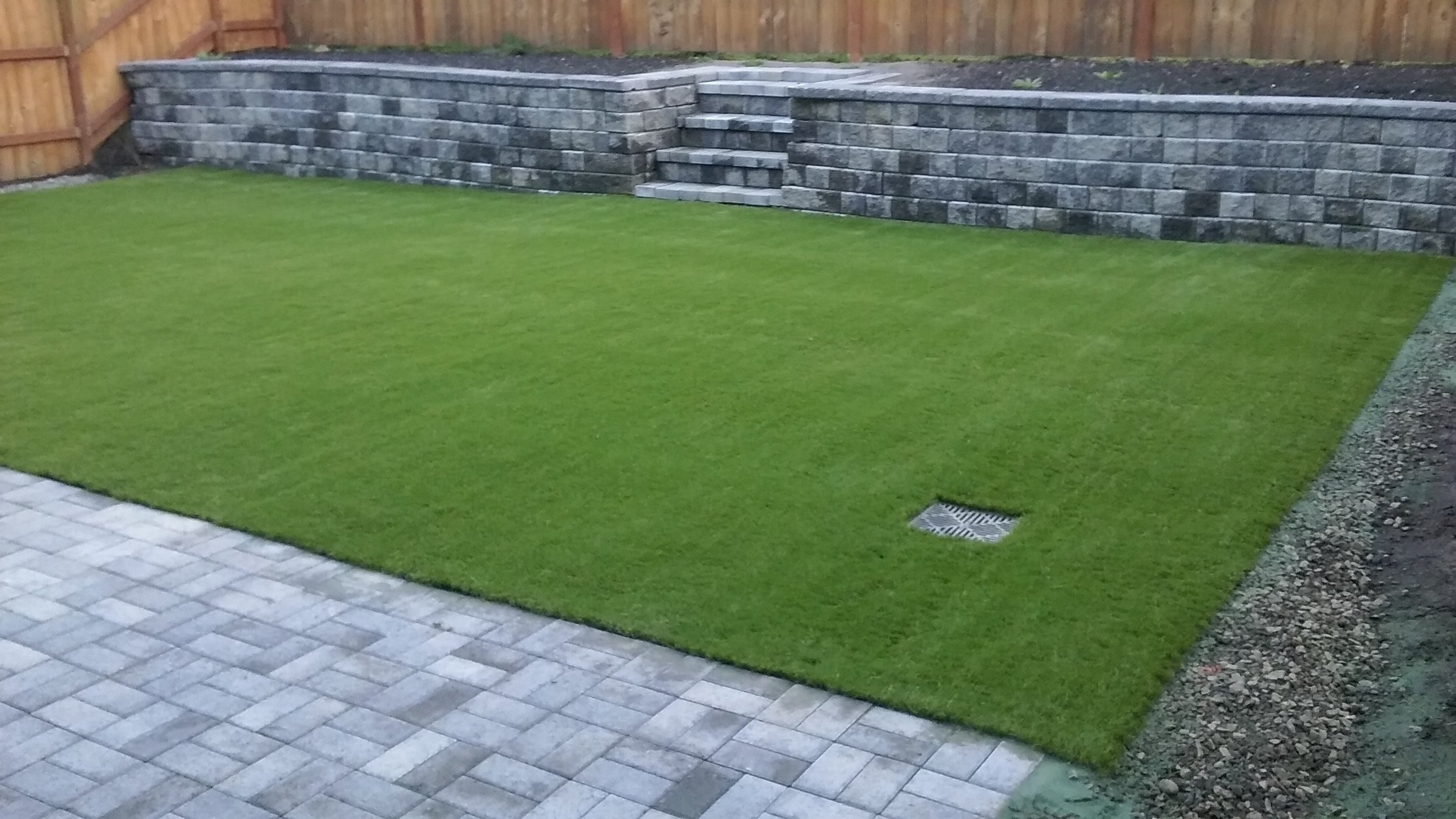
Water management on a Celina residential lot is genuinely complicated. The clay-heavy soils in Collin County that underpin Celina's master-planned communities drain slowly—a fraction of the percolation rate of sandy loam soils found in other Texas markets. The new-construction lots filling in across the 289 corridor from Old Celina Square north through Gunter were graded by builders focused on meeting closing schedules rather than optimizing long-term drainage behavior. And Celina's documented place in the Collin County hail belt means that when significant rain events arrive, they arrive fast and heavy. The combination of slow-draining soil, variable builder grading, and intense precipitation events creates drainage challenges that affect both natural grass and artificial turf—and the difference is that a well-designed artificial turf drainage system can address those challenges with engineering that natural grass simply cannot provide.
Artificial Turf of Celina's drainage solutions service exists specifically for the conditions this market creates. We design, install, and remediate drainage systems for artificial turf installations that are not performing as they should—either because the original installation did not address the soil and grade realities of the specific lot, or because conditions on the lot have changed since installation, or because the base system has experienced settling or blockage over time.
The assessment begins with a serious evaluation of the problem. We do not assume that standing water after rain is a base layer failure—sometimes the issue is at the surface, sometimes in the aggregate layer, and sometimes in the grade of the surrounding yard that is directing runoff onto the turf zone from adjacent areas. We trace water flow behavior during a standard irrigation run or, when possible, evaluate during a rain event. This observation-based approach identifies the actual failure point rather than applying a standard solution to what may be a site-specific problem.
For installations where the base aggregate has compacted over time—common in Celina's clay-heavy soil environment where fine particles migrate upward through the aggregate layer—we may need to partially lift the turf to refresh the base. This is not a failure of artificial turf as a category; it is a maintenance reality on certain soil types that was not addressed proactively. We clean the drainage holes in the turf backing, refresh or replace aggregate base material, and re-lay the turf with the corrected base.
French drain installation is appropriate when the root cause of drainage failure is not in the turf base itself but in the surrounding grade that channels water onto the turf zone. Celina lots with low-lying areas adjacent to turf zones—or lots where the builder's grading directed runoff in a direction that creates concentration points—benefit from perimeter French drain systems that intercept surface water before it accumulates on the turf. We design these systems to empty into appropriate outfall points and size them for the Collin County 100-year storm event rather than average rainfall.
Channel drains recessed into the turf surface or at perimeter transitions are appropriate for narrow turf zones, covered outdoor spaces, and commercial applications where French drains would require too much excavation. These systems require more precise installation because the drain channel must be perfectly level relative to the turf surface to function correctly, but they handle significant water volume in a limited footprint—relevant for the smaller amenity turf zones common in Celina's commercial development.
Pet yard drainage failures are their own category. The problem is usually not rainfall volume but liquid waste accumulation in base zones that have compacted around pet bathroom areas. We see this frequently in Celina residential pet yards that were installed with standard aggregate depth rather than the enhanced depth we specify for pet applications. The fix involves lifting the turf at the problem zone, refreshing the aggregate base, and—if needed—adding a dedicated drain line at the lowest point of the pet area to provide a positive outfall path.
Standing water on artificial turf is a health concern beyond aesthetics. Pooled water in a pet yard area creates a bacterial concentration zone. Pooled water in a child's play area creates a safety hazard. Pooled water under a turf surface creates conditions for mold development in the aggregate base. All of these consequences are preventable with correct drainage design, and all are correctable when the source of the drainage failure is properly diagnosed.
Artificial Turf of Celina serves drainage solution clients throughout the Celina market, Prosper, Frisco, McKinney, Anna, Melissa, Aubrey, Pilot Point, and the smaller communities along the Hwy 289 and Preston Trail corridors.
Benefits
- Observation-based assessment identifies whether drainage failure is at the surface, base layer, or surrounding grade
- Base aggregate refresh for clay-heavy Collin County soils where fine particle migration has compacted drainage capacity
- Perimeter French drain systems intercept grade-sourced runoff before it accumulates on turf zones
- Channel drain installation for narrow turf zones and commercial applications with limited excavation footprint
- Pet yard drainage repair addresses liquid waste compaction in high-use bathroom zones
- System sizing based on Collin County 100-year storm event rather than average rainfall
- Drainage hole cleaning in turf backing as part of base refresh procedures
- Prevents bacterial concentration in pet areas caused by pooled liquid waste
- Eliminates standing water safety hazards in children's play turf zones
- Post-installation observation verification confirms drainage performance across the full rain range
How the process works
- 1Drainage behavior assessment: surface observation during irrigation run or rain event to trace actual water movement
- 2Identification of failure point: surface level, base aggregate, or grade-sourced runoff concentration
- 3Soil percolation test at problem zones to evaluate clay content and native drainage rate
- 4System design: French drain, channel drain, base refresh, or combined approach based on root cause
- 5Surrounding grade evaluation and correction plan if runoff concentration is grade-sourced
- 6Turf lifting at base-level failure zones; aggregate cleaning, refresh, or replacement
- 7French drain or channel drain excavation and installation with appropriate outfall connection
- 8Turf re-installation and seam rebonding at lifted zones
- 9Irrigation-based system test to verify drainage function across the full installation
- 10Documentation of pre- and post-service drainage behavior for homeowner or property manager records
Frequently asked questions
Why do new-construction Celina lots have more drainage problems than older properties?
Builder grading on new-construction lots prioritizes getting the house to grade and meeting city code, not optimizing long-term drainage behavior for landscaping. In Celina's clay-heavy soils, this often means turf zones that lack the positive slope needed to drain promptly after heavy rain. We see this pattern regularly in Bluewood Park, Sutton Fields, and the newer phases of Fields of Celina.
Can drainage be fixed without lifting the turf?
In some cases, yes. When the failure is grade-sourced runoff from adjacent yard areas, a perimeter French drain can be installed without touching the turf. When the failure is in the base aggregate layer, lifting the turf at the problem zone is typically necessary to refresh the material that has compacted or blocked.
How does Collin County's clay soil affect artificial turf drainage specifically?
Clay soil beneath the base aggregate can create a barrier that slows water moving from the aggregate layer into the native soil below. This is why our base installations use a deeper aggregate layer and why established installations on clay-heavy lots may need periodic base refreshing more often than installations over sandier native soils.
My pet yard drains fine in dry periods but pools after rain. Is that a base problem?
Not necessarily. If the pet yard drains adequately under normal irrigation but pools during significant rain events, the issue may be runoff volume from the surrounding yard exceeding what the base can handle at that flow rate. We evaluate surrounding grade and potential French drain solutions before assuming the base needs replacement.
Will a drainage fix prevent recurring problems or do I need to plan for this again?
A properly designed drainage system matched to the actual soil and grade conditions of your specific Celina lot should provide lasting performance. We document the system design and the conditions it addresses so you have a record of what was installed and why. Soil conditions can change over time, and we note factors that might require monitoring.